
The five-channel sourcing stack you must follow.
Edition 3 of 9: Source: every outreach conversation is a data point


Edition 3 of 9 — The TA Unboxed Framework, sponsored by Metaview.
In the last edition, we looked at Attract: how to craft a compelling story that pulls the right people in and politely pushes the wrong ones away. This week, we move outbound. Source is where you carry that same story into a one-to-one conversation, and it’s where most recruiters spend their time, and most teams spend it badly.
The thesis is simple: every outreach conversation is a data point. If you treat sourcing as a numbers game, you get noise. If you treat it as market intelligence, you sharpen Define and Attract upstream, and you build a compounding advantage.
A quick word from this edition’s sponsor — Metaview
Metaview’s AI Sourcing agent now searches inside your own systems: your ATS and every past interview transcript not just the open web. Silver medallists from 18 months ago resurface. Candidates you already met, already qualified, already had a soft-skill signal on, back in your pipeline in seconds.
The promise: win the right candidates as fast as possible, without the recruiter doing the digging.
Sourcing is the supply chain. Most teams treat it like a lottery.
If Define is the brief and Attract is the magnet, Source is the supply chain. It’s the moving part. It’s where the role actually gets filled.
But here’s what I see most weeks: recruiters open LinkedIn Recruiter, type a job title, blast 200 InMails, and hope.
I wouldn’t consider that proper sourcing. I would say it’s not too dissimilar to the spray-and-pray approach for job advertising.
Real sourcing is a system with five channels, and the order matters as much as the channels themselves.
🧵 The thread from Attract → Source. Last week, we said Attract is the story that pulls the right people in. Source is what happens when the right people don’t yet know your story. Same story. Same repel principle. Different volume knob.
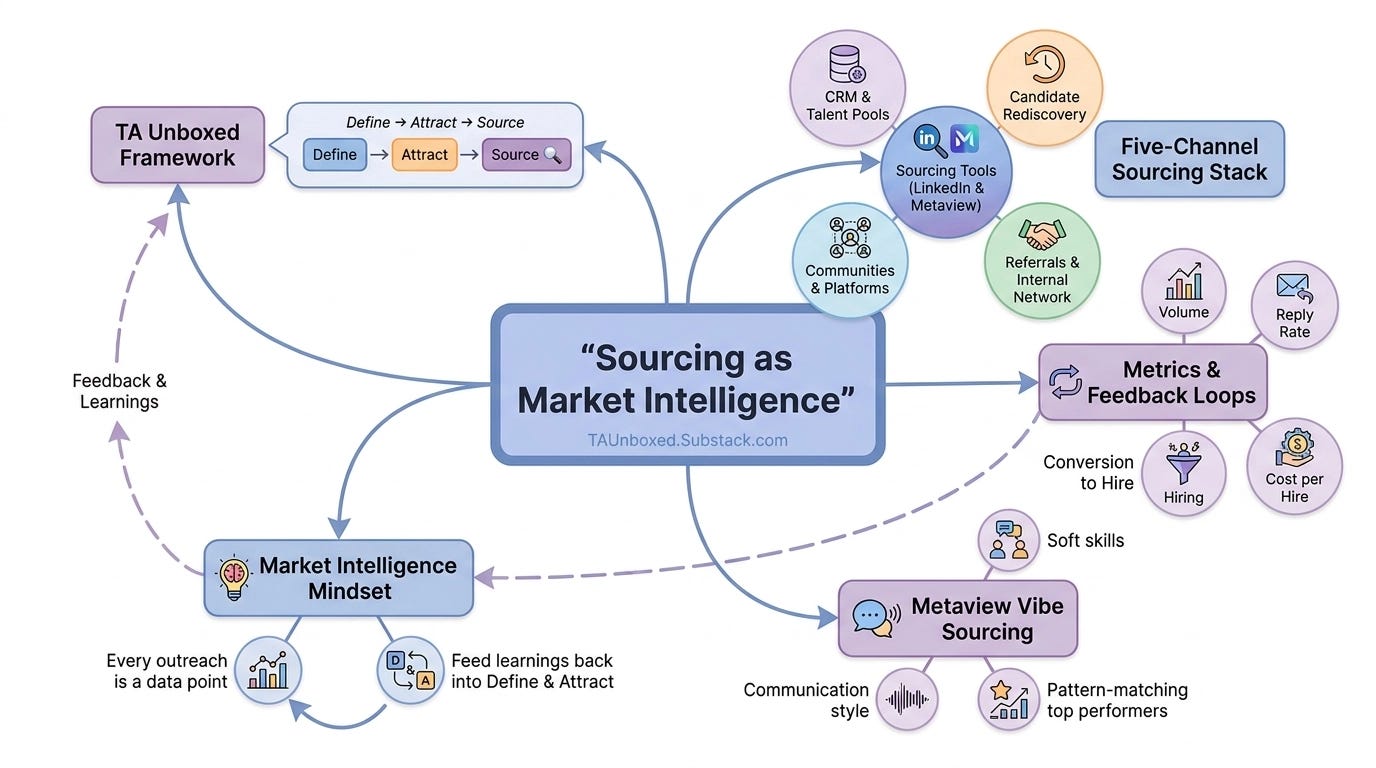
The five-channel sourcing stack
📡 Search inside before you search outside. Your CRM is your most underused asset. Every candidate you’ve ever engaged is in there. Search it first — before LinkedIn, before any external tool.
1. CRM, talent pools and pipelines — your first stop, every time
These are the same assets, just at different levels of structure. The CRM holds every candidate you’ve ever engaged. Pipelines are the pre-built shelves on top, organised by practice area, auto-populating every time a new candidate enters your ATS or talent community, with silver medallists pooled automatically. Search here before you go external. Track pool health weekly; built once and forgotten is the failure mode. If you skip this step, you’re paying twice for the same person.
2. Candidate rediscovery agent
The AI layer that actively re-surfaces candidates already in your systems — silver medallists, lapsed pipeline members, anyone you’ve spoken to before but never closed. Where the CRM is the warehouse and pipelines are the shelves, the rediscovery agent is the assistant who walks the aisles whenever a new role opens, bringing the right names to the front.
If you’re not running one yet, it’s the highest-leverage channel you can add this year. Even better, this is outsourced to an agent, allowing you to focus on building relationships with others at the same time.
3. Sourcing tools — LinkedIn, and now Metaview vibe sourcing
LinkedIn Recruiter is still the workhorse: Boolean strings straight from the ICP in your Define brief, profiles imported to the CRM, response rates benchmarked per recruiter and per role type. But the game is shifting fast — Metaview vibe sourcing changes how this whole channel works. More on that below.
4. Where your candidates actually are
Not just job boards. The right place depends on who you’re hiring. Engineers live on GitHub and Stack Overflow. Designers are on Dribbble and Behance. Product managers in Lenny’s Slack. Salespeople in Pavilion. Find the watering hole before you go looking for the candidate.
5. Referrals and your internal network
Still the highest-converting channel by almost every benchmark I’ve seen, most teams have no real process beyond “tell your friends.” (This is the same supply-chain layer we closed Attract on. In Attract, your employees and managers spread the story. In Source, they name names.)
Your employees know who’s good. They’ve worked with them. A 10-minute coffee with three engineers surfaces better names than two hours on LinkedIn.
Your hiring managers have networks and ex-colleagues. They will tell you who’s about to be unhappy at a competitor if you ask.
A structured referral programme with a cash bonus, recognition, and a feedback loop converts 5-10x cold outbound.
If you’re not actively mining these three, you’re leaving your best candidates on the table.
Track every channel or you’re flying blind
A stack you don’t measure is just a list. Each of the five channels above needs its own scorecard:
Volume in — how many candidates entered from this channel?
Reply or response rate — what percentage actually engaged?
Conversion to hire — how many became offers, then accepts?
Cost per hire — tool fees, recruiter hours, and referral bonuses included.
Without those numbers, you can’t tell which channel deserves more investment and which one is quietly burning your team’s time. Every channel needs an owner, a target, and a weekly check-in.
The Glen Cathey thesis: sourcing is market intelligence
Glen Cathey has been making one argument louder than anyone else lately: every outreach conversation is a data point. If you’re not feeding it back into Define and Attract, you’re just burning messages.
Here’s what that looks like in practice:
A candidate tells you the salary band is off → that’s a data point for Define.
Three candidates say the job ad reads like every other one → that’s a signal for Attract.
Nobody is responding to your subject line → that’s a hypothesis to test, not a reason to send more.
A candidate mentions their manager just left → that’s intelligence on a competitor team about to wobble.
Cathey also said something else that landed hard: 20 sourced beats 18,000 applied. He posted recently about a company that received 18,000 applications for one role. Eighteen thousand. The team couldn’t process it. They ended up hiring through outbound anyway.
His point: in an AI-application-flood world, outbound sourcing is becoming sexy again, dare I say that phrase, because it’s the only channel where you control the signal.
What good outreach actually looks like
Before we get into tactics, the one principle from the last edition that matters more here than anywhere else is this: your outreach email is the one-to-one version of the Attract story. Don’t reinvent it for every send. Pull it straight from the Job Ad, the EVP angle, and the Candidate Playbook you already built. Said once. Said well. Said consistently across every channel.
I remember a great episode with Robin Choy from HireSweet on “How to improve your candidate outreach.” A few things stuck for me:
Follow up twice. You’ll double your replies. Most recruiters send one message and move on. Two follow-ups, spaced 3-5 days apart, double response rates. It’s the cheapest lift in sourcing.
Multi-channel beats single channel. Send a LinkedIn invite and an email simultaneously. Don’t pick. Pick both.
50 to 100 messages a day, not thousands. Quality of the list beats the volume of the send. Always.
Lower the friction of your CTA. “Mind if I send you the Job Ad?” converts better than “Open to a 30-minute call Friday at 2pm?” Ask for less, get more.
Warm contacts crush cold ones. A second-degree intro from someone you know is worth ten cold InMails.
Measure to improve. If you’re not tracking open rate, reply rate, and meeting conversion per template, you’re guessing.
Robin’s best line: “If you’re fighting Google’s spam filters, they’ll always win. Build your own community instead.”
The thread back to Attract. Every rule we wrote for job ads last week applies to outreach, too. Specific opener, not corporate. Read it out loud. Repel the wrong people on purpose. Tone signals what kind of place you are before you’ve said a word about the role. An InMail that sounds like a mail merge is just a bad job ad with a smaller audience.
The point: don’t optimise for sending more. Optimise for sending better, and own the channel you send through.
Metaview vibe sourcing — finding candidates with the right vibe
Here’s what’s shifting. Classic LinkedIn sourcing matches on keywords: title, skills, years of experience, and current company. That’s a low barometer to start off with. Two candidates with identical LinkedIn profiles can be wildly different hires.
Vibe sourcing uses qualitative signals, such as soft skills, motivators, communication style, and the energy you actually heard in past interviews, to find candidates who match the real profile of your best hires.
Metaview is leading on this, because they sit on every interview transcript your team has ever run, they can answer questions a Boolean string never could:
“Find me candidates who sound like Sarah on the call where she explained the architecture refactor.”
“Find me engineers who described their last role with the same level of ownership our top hires did.”
“Find me people whose answers on ‘why are you leaving?’ match the pattern of candidates who stayed 3+ years.”
That’s pattern-matching on how people actually talk and think, the vibe, not the keywords.
It’s early. It’s directional. But it’s the most interesting shift in sourcing tooling I’ve seen in five years. If you’re a Metaview customer, ask them to walk you through it.
What to do this week
Search your CRM and ATS before you open LinkedIn. Every time. Make it a rule.
Build one 50-80 person target list per open role, straight from the Define brief. Two hours of work. Better than a job ad you don’t control.
Add a second follow-up to your default outreach sequence. Measure the lift in replies after two weeks.
Lower the friction of one CTA in your templates this week. Swap “book a call” for “mind if I send the JD?” and see what happens.
Capture one new data point from every outreach conversation and feed it back into the Define brief. Salary, motivators, deal-breakers, competitor signals — all of it.
The bottom line
Sourcing isn’t a volume game. It’s a signal game.
Every conversation is intelligence. Every reply, or no-reply, tells you something about the brief, the market, or the message. The teams that win don’t send more. They send better, and they learn from every send.
CRM first. Five channels in order. Tracked, owned, measured. The same story I wrote in Attract: compelling, specific, honestly told, carried into every outreach and back into a closed loop with Define and Attract.
Sourcing without Attract is cold outreach with a bigger budget. Attract without Sourcing is hope. Run them as one system, and the story you told the market starts telling itself back to you.
That’s sourcing as market intelligence.
Next edition — Engage and Screen
Once you’ve sourced the right people, the work shifts again. Engage and Screen is about how you actually convert a stranger into a candidate and ensure the candidates you move forward with are the right ones. We’ll get into the conversation itself: what to ask, what to skip, how to screen without killing momentum, and how to handle the moment a great candidate goes quiet.
📣 This edition was brought to you by Metaview.
If you want the kick-off transcript to become your sourcing brief and silver medallists to resurface automatically, go take a look:
Explore Metaview Sourcing · Watch the demo
Hit reply and tell me: what’s the one outreach data point you’ve captured this month that changed how you brief a role? I read every reply.
— Darren Bush, Founder of TA Unboxed.