
Is the CV triage process broken?
Edition 4 of 9 (Screen and Engage)— The TA Unboxed Framework, sponsored by Metaview.


Last edition, we looked at Source: sourcing as market intelligence, every outreach conversation a data point. This week, we move to Engage and Screen: the part of the funnel where most teams lose great candidates without even realising it.
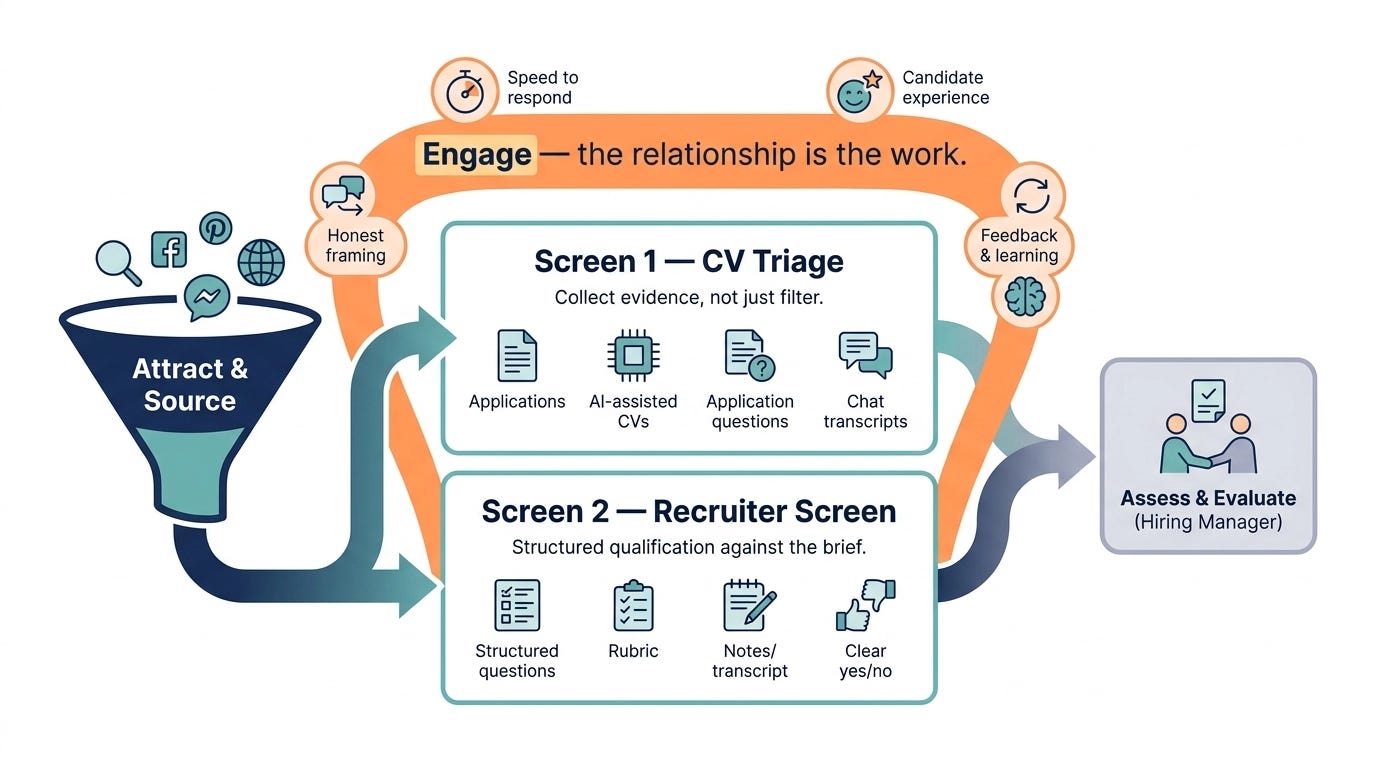
Engage isn’t a stage. It’s the relationship layer that runs through everything. “Screening” isn’t one moment: it’s two: CV triage on paper (Screen 1), then the recruiter screen in conversation (Screen 2), with Engage wrapped around both.
A quick word from this edition’s sponsor — Metaview
If you’re overwhelmed with applications, the question is, what do you do to mitigate or manage this? Metaview’s answer is Application Review, the AI agent that reviews every inbound applicant against your definition of great, and surfaces the strongest matches the moment they apply.
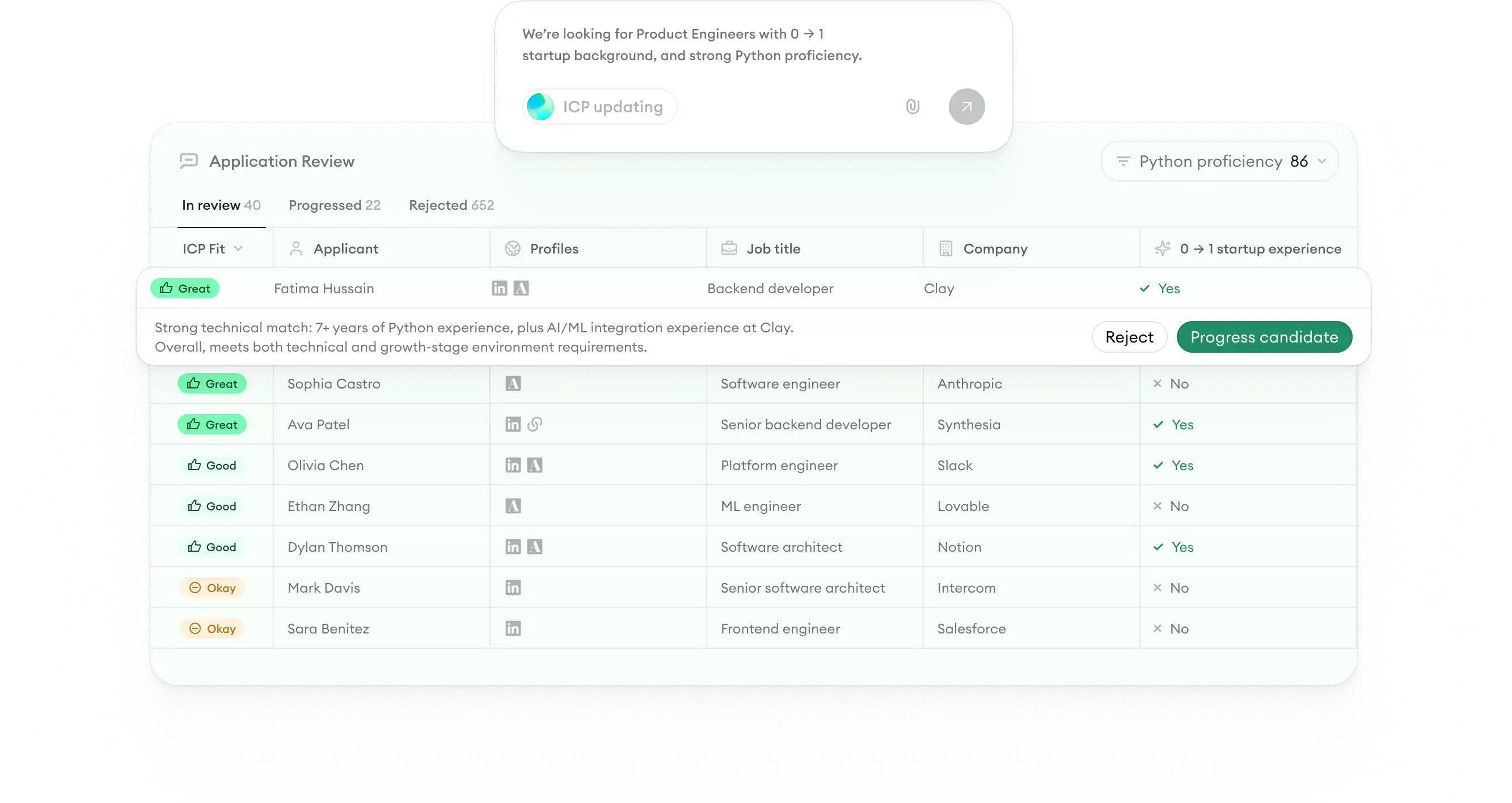
Here’s the bit that matters for this edition: it never auto-rejects. Humans define the Ideal Candidate Profile in the kickoff call. The agent reads every application against it. Humans decide who moves forward. The model sharpens from every accept and reject.
And because Application Review sits on the same context layer as Metaview’s Sourcing, Notes and Outreach agents, the brief that drives sourcing is the same brief that drives screening. One ICP, end-to-end.
Teams using it are seeing up to 92% less time spent on inbound screening, time which goes straight back into the relationship work this edition is really about. Metaview is the platform for specialist AI agents to compound intelligence and efficiency.
The reframe: one continuous relationship, two distinct screens
Most teams collapse Engage and Screen into a single step: a recruiter reads the CV, picks up the phone, and tries to do three jobs in 20 minutes: sell the role, qualify the candidate, write the shortlist.
That model breaks the work into two ways. It treats Engage as a stage you finish (it isn’t — it’s continuous), and it treats Screen as one thing (it isn’t — it’s two).
Here’s how the work actually flows:
CV Triage (Screen 1) — digital review, on the evidence supplied. Recruiter-owned.
Engage — the relationship layer. Conversion, honesty, listening, and the offer narrative. Recruiter-owned, continuous from first touch to offer accept.
Recruiter Screen (Screen 2) — the qualification call against the brief. Recruiter-owned.
→ handoff to Assess and Evaluate — hiring-manager-owned.
For sourced candidates, the order looks different at the top; you reach out first, but you’re still mentally CV triaging from the moment you scan the list. Sourcing is searching through endless lists. The triage instinct is the same; the artefact just turns up later.
Screen 1 — CV Triage: the broken stage
Here’s the question we’re all currently facing in this new world:
When every application is AI-assisted, what are you actually triaging?
The data is already pointing that way. Jason Miller ran a brilliant little experiment, same role, a stack of resumes from the last 30 days against a stack from 2024 and the shift is what we are all subconsciously noticing.
Average resume length up 20%.
One-page resumes have gone from 12% of the pool to zero.
Resumes over 3 pages up 50%.
Resumes over 7,000 words doubled.
However, this is the most telling stat from his experiment, inside the text: quantified impact claims (every bullet ending in “X% improvement”) up 124%; AI power verbs (spearheaded, architected, pioneered, leveraged, engineered) up 131%; result-oriented phrases (resulting in, achieving, improving, reducing) up 211%.
His own verdict — “the signal-to-noise ratio for recruiters has collapsed. We’re now parsing 20% more text per candidate, and that text is 2-3x more dense with unverifiable claims.”
It’s a great piece of analysis and deserves a lot more traction than it’s getting. Definitely worth a read - (I just downloaded a ton of resumes… — Jason Miller on LinkedIn.)
Go back a step. What are we actually trying to do?
The goal isn’t to shrink the pool. The goal is to identify the best candidate for the role you defined at kick-off. (I would go further and say it’s to find a great candidate for the company (it doesn’t have to be for that role). Everything before this stage exists to feed that goal:
Attract exists to reach the widest pool possible.
Source exists to reach people who’d never see the advert.
The widest funnel possible isn’t a vanity metric. It’s the whole point.
So if the goal is the best candidate and the strategy is the widest funnel, CV triage can’t be a filter that shrinks the pool to a handful based on whichever 600 words the candidate (or their AI) put in a CV.
It has to be something else entirely.
What the future looks like for Screening and what you need to think about
If the CV is one input and an increasingly compromised one, what are the others? Five things every application stage could be collecting today, but I assume will be in years to come:
Application questions. Three to five sharp ones, tied to the success profile. What’s the smallest thing you’d ship in the first 30 days? Real, role-specific, signal-dense.
An on-site chat. A simple text conversation triggered when the candidate hits Apply. Ninety seconds. Three rotating prompts. Captured as a transcript. Questions about location, right to work.
Text or WhatsApp. The channel candidates actually use. Async, low-friction, mobile-first.
A short AI conversation. Structured, rubric-based, the same questions for every candidate. (See the wave of AI-interviewer tools coming on the market, expect more.)
A second interface at apply time. A dedicated layer where the candidate can give you more voice notes, links to work, short written answers, and a quick video, knowing it will all be assimilated and surfaced, not lost inside a PDF parser.
The point isn’t to add friction. However, you speak to some TA people, and they would love to reduce the number of AI applications. The point is to shift the friction earlier and let the candidate provide the evidence themselves, rather than asking the recruiter to extract it from a CV.
TA teams will have to weigh this up: how much capture do you want? For executive hiring, you want as little as possible, I get it.
Engage — the relationship layer (the heart of this edition)
Here is the strange thing about Engage. It is simultaneously the stage most exposed to automation and the stage where a capable human recruiter is most irreplaceable.
Recruitment is relationships. If you want the offer, you build the relationship throughout. Engage isn’t a stage you finish at the screen. It’s a continuous first touch to offer acceptance, and beyond.
Here’s what good Engage looks like in practice.
1. Speed beats polish — and start measuring time-to-respond and candidate waiting time
A reply within 24 hours doubles your conversion. A reply within an hour doubles it again. The candidate has applied to four roles this week; whoever talks to them first usually wins.
Tyler Weeks at Marriott makes the structural version of this argument: we should stop reporting time-to-hire and start reporting time-to-respond, because time-to-respond is the metric candidates actually feel and the one that predicts whether they’re still warm by the time you call. (Hiring Excellence by Social Talent — Data That Actually Helps: Marriott’s TA Metrics Playbook (with Tyler Weeks).)
I’ve made the related argument with my own metric — Candidate Waiting Time (CWT), which tracks how long a candidate goes without hearing from you at any point in the process. Time-to-respond is the first touch. CWT is every silence after that.
2. The first conversation is sales, not screening
You are not yet qualifying the candidate; you are earning the right to. Lead with the role’s real story (the one you wrote in Attract), name the things most candidates worry about before they raise them, and ask one open question: what made you reply? The answer tells you more than any rubric.
Annie Wenzel runs every search this way. The thorough intake at the start is what stops misalignment later, and the candidate experience along the way is brand equity, not a soft metric. (10x Recruiting by Metaview — The recruiter behind the best GTM execs.)
3. Be mindful of the friction — and know which step to skip
As discussed, you’re trying to collect information; the more senior the role, the harder this becomes at the screen stage.
This is the bit where the recruiter’s craft shows up most clearly. A capable recruiter knows which steps can be skipped, which questions can be asked over WhatsApp, and which conversations have to happen on the phone.
4. Tell the truth fast
If salary is fixed, say so. If the role is hybrid, say which three. If the team has just lost a senior leader, say it.
Kim Bryant’s talent-intelligence data across 400,000 hires in 100 countries makes the same point at scale: candidate experience beats compensation as the reason offers get declined. What candidates remember isn’t the salary — it’s how it felt to talk to you. (The Talent Intelligence Collective Podcast — The one where Kim Bryant returns.)
5. Treat “no” as data, not failure
Every candidate who declines tells you something about Define, Attract or Source. Capture the reason. Feed it back.
Engage is where market intelligence is at its richest. The candidate has just told you, in their own words, why the role doesn’t fit. (See Edition 3 — sourcing as market intelligence.) This is also the thread that runs all the way to Validate at the end of the framework: if you don’t capture the why at every conversation, you have no data to learn from later.
6. Give every candidate real, human feedback — including the ones you don’t progress
This is the bit most teams quietly skip. JCB built an entire early-careers programme around it: 8,000 applications a year, meaningful feedback regardless of the outcome, and a deliberate choice to make the experience fair enough that candidates don’t need to cheat to get through it. (The Score by SOVA — Make It So Candidates Don’t Need to Cheat: How JCB Hires Early Talent.)
Screen 2 — the Recruiter Screen: where qualification actually happens
If Engage is doing its job, the candidates who reach the Recruiter Screen are already self-selected, informed, and motivated. That changes what this stage has to do.
This is a qualification, not sales. The relationship is established. Now you’re deciding whether this candidate, on the evidence in front of you and the conversation you’re about to have, matches the brief you wrote in Define.
Different job, different skill, different artefact. The Recruiter Screen at its best is:
Structured. Same core questions for every candidate at this stage. Same rubric. Same notes structure.
Anchored in the brief. Every question maps back to the success profile from Define.
Captured. Not on a Post-it. As a transcript or a structured note that the hiring manager can read and the team can compare.
Decisive. A clear yes / no / next-step out of it — with the reason logged.
It never stops being part of Engage. The relationship is still being built while the qualification is happening. The recruiters who do this well don’t switch modes; they hold both at once.
How Metaview fits
Metaview is the assimilation layer for the hiring conversation.
Application Review uses the same kick-off rubric to triage inbound applications — collect and assimilate, not filter. Every applicant is read against your brief; the strongest matches are surfaced; the recruiter still decides.
The kick-off transcript becomes the screening rubric, not a separate doc someone has to write.
The Recruiter Screen is captured, structured, scored against that rubric, and made comparable across recruiters.
The output is a clean profile per candidate, anchored in their actual words, ready for the hiring manager.
Every decision is auditable — why was this candidate advanced or rejected? — by the time anyone asks.
That’s the assimilation layer. The decision still belongs to the recruiter. The defensibility belongs to the team.
What to do this week
Hold the three ownership lines. Screen = recruiter. Engage = recruiter. Evaluate = manager. Write them on a Post-it if you have to.
Split CV Triage and the Recruiter Screen in your own head. Two jobs, two artefacts, two moments. Stop treating them as one phone call.
Cut your time-to-respond in half. Whatever it is today, halve it. Then start measuring Candidate Waiting Time alongside it, every silence in the process, not just the first one.
Drop the binary frame at CV triage. Stop talking about it as pass / fail. Start talking about it as collect, assimilate, surface, decide.
Audit your application form. If the only candidate input is a CV upload, you’re under-collecting. Add three role-specific application questions today.
Hold the line on AI. Whatever vendor you use, the rule is: AI converges the inputs into a comparable profile. AI does not produce a yes/no recommendation. The recruiter does that.
The bottom line
Engage isn’t a stage. It’s the relationship layer that runs through the whole funnel, from the first reply to the offer accept. Recruitment is relationships. If you want the offer, you build the relationship throughout.
What we used to call “screening” is actually two jobs wrapped around that relationship:
CV Triage — broken in its old form, fixable as a collection layer. You’ll start to see AI take a more prominent position in collecting and assimilating information.
Recruiter Screen — more important than ever, the place craft shows up. The recruiter’s job to decide.
So the line through it all that I expect to see over the next 18 months is: AI assimilates. The recruiter decides. The hiring manager evaluates.
Get those three lines right, and Engage becomes what it always should have been, not a stage you finish, but the relationship that turns a wide funnel into a great hire.
Next edition — Assess
Once you’ve engaged the right people and surfaced the right shortlist, the next question is sharper: how do you know they can actually do the job? Assess is where evidence beats instinct: structured, role-relevant, integrated with everything you’ve already collected. We’ll look at where assessment adds a genuine signal, where it just adds friction, and how AI might be quietly changing both.
Hit reply and tell me: where in the flow- CV Triage, Engage, or Recruiter Screen — does your team lose the most candidates? I read every comment.
Darren Bush, Founder of TA Unboxed.